
Most holiday influencer gifting fails because of timing, not because of the creators. A box that arrives on November 20 turns into a post on December 3, when your best offer has already ended. In this guide we lay out the Q4 seeding calendar we use at C4: who goes on the list, the dates to ship so posts land before Black Friday (November 27 this year), and how to tie every gifted post back to revenue.
It’s October 18 as we write this, so the timing is tight but workable. Here’s the full plan, worked back from the dates that matter.
Why influencer gifting timing matters more in Q4
The holiday buying window keeps opening earlier. Adobe forecasts $95.8 billion in online spending during October, an 8% increase. Across the whole season, Adobe expects online sales to hit $275.1 billion this holiday season (Nov. 1 to Dec. 31, 2026), growing 6.7% year-over-year.
Demand is also bunched into a few days. Cyber Week (the five-day period between Thanksgiving and Cyber Monday) is set to drive $47.5 billion online (up 7.4% YoY), representing 17.3% of the full holiday season spend. Discounts climb in steps on the way there. Adobe forecasts discounts of as much as 30% during Cyber Week, with promotions reaching up to 14% in early November, 21% before Thanksgiving and 10% to 15% throughout December.
For seeding, that means one thing. Your creator content has to be live while shoppers are building their lists, not after they’ve checked out. We treat the two weeks before Thanksgiving as the window that matters most, because organic posts can still get seen before every brand’s paid budget floods the feed.
Who to seed: building your holiday influencer gifting list
Most brands get the list wrong long before any box ships. Traackr’s research found that marketers ranked “finding the right influencers” as the number one challenge for producing successful influencer product seeding campaigns. The cost of a bad list shows up quickly. 61% of marketers reported that less than half of influencers receiving gifted products actually post on social media.
So for Q4 we don’t build one big list. Instead, we split creators into three groups, and each group has a different job and a different send date.
The three-tier holiday seeding list
| Tier | Who they are | Their Q4 job | Share of boxes |
|---|---|---|---|
| 1. Proven advocates | Creators who posted about you before, unpaid, and customers with an audience | Reliable pre-Black Friday posts with your code | About 30% |
| 2. Gift guide curators | Creators who already publish “gifts for her,” “stocking stuffers” or “gifts under $50” content | Put your product on a gift list your buyer is already scrolling | About 40% |
| 3. Conversion creators | Smaller accounts whose audience clearly buys (shop links, swipe-ups, comments asking “where’s this from”) | Raw creative for partnership ads plus code sales | About 30% |
These percentages are our starting split, not an industry rule. A brand with a big base of existing fans should put more weight on Tier 1. On the other hand, a brand launching a new giftable product should lean into Tier 2.
Vetting checks before anyone gets a box
We run every creator through five checks. Anyone who fails two gets cut, however good their follower count looks.
- Audience location. Traackr suggests asking is the influencer’s audience in a location where they can easily buy your brand’s products? For a US Shopify store, mostly international audiences make for expensive vanity reach.
- Holiday posting history. Did they post gift content last November? Creators who skip Q4 every year won’t change their habits for your box.
- Brand affinity. Look for brand love or worked with similar brands in the last six months.
- Comment quality. Read 50 comments. Questions about price, sizing or where to buy point to buying intent. Emoji strings and “love this” don’t.
- Sponsored post density. If every third post is an ad, your gifted product will get lost.
Then ask for an opt-in before you ship. Unsolicited boxes waste product at the worst possible time of year. Traackr also recommends that you allow influencers to select their own gifted products. In practice, we send a short DM or email with two or three product choices and ask the creator to confirm their address. A yes is a much better predictor of a post than a follow.
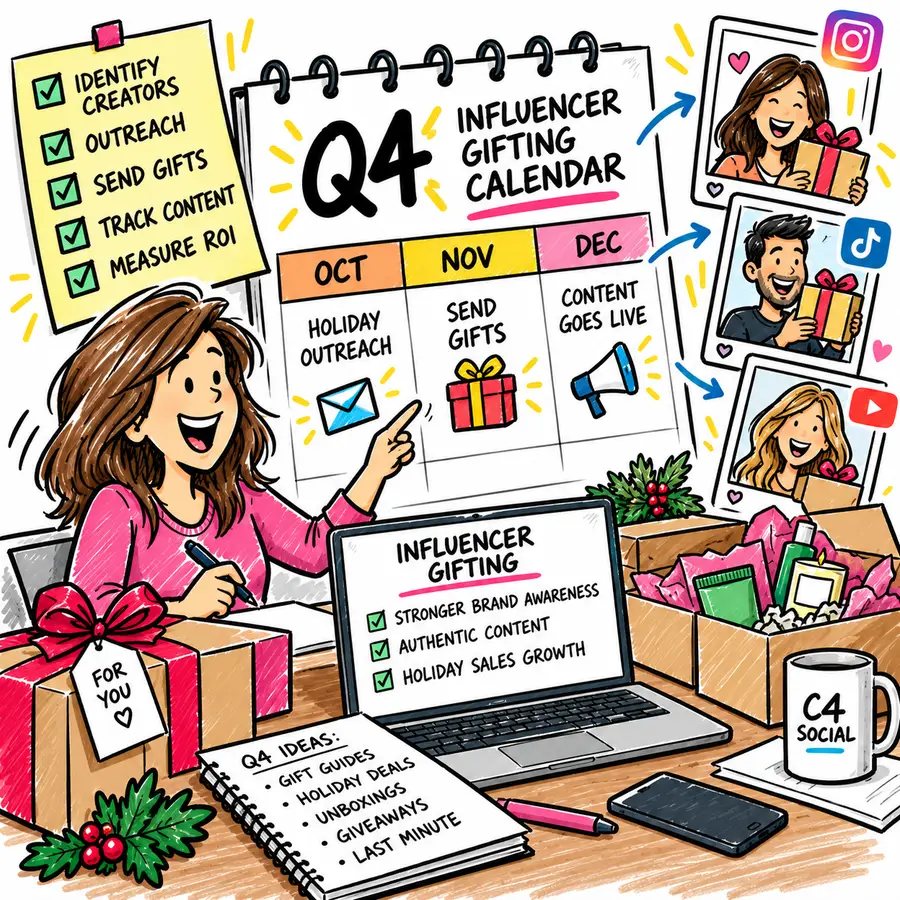
The Q4 influencer gifting calendar, working back from Black Friday
We plan the calendar backward from the day we want posts live. Generally, creators need 7 to 14 days after delivery to use the product, shoot it and fit it into their own schedule. Shipping takes 3 to 5 business days, so add a buffer for carrier peak season.
That buffer matters more this year. According to ShippyPro’s 2026 peak season guide, USPS holiday pricing runs from October 4, 2026 to January 17, 2027, UPS peak season starts on October 25 and FedEx on October 26, and both run into mid-January. Plan your shipping budget with peak rates built in.
| Dates (2026) | Action | Notes |
|---|---|---|
| Oct 19 to Oct 23 | Finalize list, send opt-in outreach, collect addresses, create codes and links | Write the brief and gift note this week |
| Oct 26 to Oct 30 | Ship Wave 1 (Tiers 1 and 3) | The most important send of the quarter |
| Nov 2 to Nov 6 | Ship Wave 1B (Tier 2 gift guide curators) | Curators often build their lists in mid November |
| Nov 9 to Nov 20 | Target posting window | Check in 5 to 7 days after delivery; log posts daily |
| Nov 16 to Nov 25 | Run the best posts as partnership ads | Get permissions before Cyber Week CPMs jump |
| Nov 26 to Nov 30 | Cyber Week: no new shipments | Ask creators to reshare codes in Stories |
| Nov 30 to Dec 2 | Ship Wave 2 (December gifting push) | Hanukkah runs Dec 4 to 12 this year |
| Dec 7 to Dec 16 | “Last chance to ship” creator content | Line it up with your store cutoff |
Wave 1: the pre-Black Friday send
Wave 1 carries the most weight. Creators who get a box in the first week of November can post during the November 9 to 20 window. At that point shoppers are still researching, and early discounts are running at around 14%. Posts that go up then keep getting views and saves all the way into Cyber Week.
If you can’t get boxes out by November 6, our honest advice is to skip the pre-Black Friday wave. Put that product budget into Wave 2 instead. Late boxes tend to produce posts after Cyber Monday, when your strongest offer has already ended.
Wave 2: the December gifting push
December content is about gift ideas and arriving in time, not about deals. Your store cutoff sets the deadline. On the USPS holiday shipping page, the contiguous US recommendations are USPS Ground Advantage® Service | Thursday, Dec. 17, with Priority Mail a day later. USPS also points out that Hanukkah (Dec. 4 – Dec. 12) is earlier this year so please adjust accordingly.
Ask Wave 2 creators to post between December 7 and 16, and include your order-by date in the brief. Once your cutoff passes, move any remaining creator content over to gift cards or New Year use cases.
What goes in the box (and in the brief)
A holiday box has to do more than look good when it’s opened. Every box we send includes four things:
- A personal note that names something specific the creator has made. Generic “we love your content” notes come across as a mass mailing.
- A one-page brief with two or three angles (gift for a specific person, price point, the problem it solves). Also include the holiday dates and your offer timing. Keep it a suggestion, not a script.
- A code card with the creator’s personal code, link and expiry date.
- A disclosure reminder written in plain language (more on that below).
Gift guide editors and journalists need something different: product shots, pricing and stock details in a format they can drop straight into a roundup. We covered that in detail in our guide to gift guide press kit examples. Run your press and creator seeding together, but keep the assets separate.
How to track influencer gifting back to sales
This is where most programs fall apart. The Influencer Marketing Hub 2026 Benchmark Report shows that promo/discount codes lead adoption (45.9% of those answering), followed by affiliate links (26.0%) and native shop features (25.0%). Codes are a good start, but they’re only part of the picture. We use four layers together.
Layer 1: unique codes and links for every creator
Every creator gets their own discount code and their own UTM-tagged link. If you’re on Shopify, the Shopify Collabs app is the simplest native option, because you can use Shopify Collabs to send gifts or discount codes, track affiliate sales, and send payments to creators.
Decide early how codes interact with your Black Friday sale. If codes stack on top of a 25% sitewide discount, margins can disappear fast. Our usual setup is a code that gives a free gift with purchase, or one that only works on non-sale bundles. Also put usage limits on codes. Shopify specifically lists discount code leaks among its Collabs guideline violations, and coupon sites do grab Q4 codes.
Layer 2: a post log updated every day
Codes don’t show you what went live. We keep a simple log for each creator: ship date, delivery date, post date, format, link to the post, views at 48 hours, and code redemptions. That log gives you your real post rate. It also tells you who earns a box next year. Traackr found that 65% of marketers reported that their brand will keep sending products to influencers, even if they didn’t post after receiving a previous gift. Don’t be one of them.
Layer 3: measure the halo, not just the code
Many buyers see a creator’s post and then search your brand name on Google a few days later. The code gets no credit for that sale. To catch it, add a post-purchase survey question (“Where did you first hear about us?”) that includes a creator option. Then watch branded search volume and direct traffic during each posting window.
At the business level, track blended efficiency rather than last-click numbers. We explain how in our post on MER vs ROAS. If MER holds steady during the seeding window while total revenue goes up, the halo is working.
Layer 4: turn the best posts into partnership ads
Gifted content often earns back more in paid media than it does organically. When Meta introduced its Partnership Ads Hub updates, Marketing Dive reported that the addition of partnership ads to marketing campaigns delivers 19% lower CPAs and 13% higher click through rates on average, according to data shared in the press release. Brands can now also see content from creators who tag or mention their brand directly inside the hub.
So ask for partnership ad permission in your opt-in message, before the box ships. Asking afterward, in the middle of Cyber Week, usually means slow replies. Also make sure your tracking works before you put money behind creator posts. Our Meta Pixel Helper guide for Shopify walks through the checks.
The creator scorecard
| Metric | What it tells you | Action threshold |
|---|---|---|
| Posted (yes/no) | Reliability | No post means no box next season |
| Code orders and revenue | Direct conversion | Revenue above box cost means re-seed |
| Saves and shares | Gift intent | Top 20% get tested as partnership ads |
| Partnership ad CPA | Paid scalability | Below your target CPA means scale spend |
| Survey mentions | Halo effect | Repeat mentions mean move them to paid |
The math: what a holiday influencer gifting program needs to return
Here’s a sample budget. Say you seed 60 creators. Each box costs $25 in product (at cost), $6 in packaging and inserts, and $9 in peak-season shipping, so $40 per creator and $2,400 in total.
We plan around a conservative post rate of 30%, which gives roughly 18 posts. That works out to about $133 per live post before any sales. The real question is how many of those 18 posts can carry their own weight, either through code revenue or as partnership ads that beat your current creative.
Run the program against your break-even numbers, not a gut feeling. If your contribution margin per order is $30, the $2,400 is covered by 80 attributed orders, before counting any paid amplification. If you haven’t worked out that threshold yet, start with our guide on how to calculate ROAS and break-even ROAS. The same logic applies to gifting spend.
Staying compliant: disclosure for gifted posts
A free product creates a disclosure obligation, even when you didn’t ask for a post. The FTC’s Disclosures 101 for Social Media Influencers says a material connection includes a financial relationship, such as the brand paying you or giving you free or discounted products or services. The FTC also says simple explanations like “Thanks to Acme brand for the free product” are often enough if placed in a way that is hard to miss.
Disclosure isn’t only the creator’s job. One 2026 brand guide points out that the brand that hired them is also responsible for briefing them, monitoring their posts and correcting mistakes. That’s why our briefs include the exact wording to use, and our post log has a “disclosure present” column. If a post is missing one, we send a polite DM the same day.
Influencer gifting FAQ
When should I send influencer gifts for the holidays?
For posts to land before Black Friday, get boxes out between October 26 and November 6. Creators need roughly one to two weeks after delivery to post. If you miss that window, plan a December wave that ships around November 30 to December 2.
How many creators should a DTC brand seed in Q4?
Begin with the number of creators you can actually vet, brief and follow up with. For most brands doing $1M to $10M a year, that’s 40 to 100 creators. A smaller list that’s well vetted and opt-in will beat a large cold list on post rate and on revenue.
Do influencers have to disclose gifted products?
Yes. FTC guidance treats free products as a material connection. Creators should disclose clearly in the post itself, for example “Thanks to [brand] for the free product,” even if nobody asked them to post.
How do I measure influencer gifting ROI?
Combine unique codes and UTM links with a daily post log, a post-purchase survey and blended MER. Then track how the best posts perform as partnership ads. Code revenue alone almost always understates the impact.
Should I pay creators instead of gifting?
Gifting is good for discovery and for testing creative. Payment makes sense for creators who already drove sales or produced winning ads. Many of our clients use Q4 gifting results to pick their paid creator roster for the following year.
Make Q4 seeding pay for itself
Influencer gifting works best when it’s run like a media channel, with a calendar, a scorecard and a direct line into paid social. That’s how our Social Media Management team runs seeding for DTC brands: creator vetting, outreach, briefs, post tracking and partnership ads, all reported against revenue rather than likes.
If you’d like a second opinion on your holiday seeding list or calendar before boxes go out, book a quick call with the C4 Social team. We’ll go through your timing and tracking setup and tell you honestly what we’d change.
Sources
- Adobe: U.S. Holiday Shopping Season to Hit Record $275.1 Billion Online, Rising 6.7% YoY
- Inside Radio: Adobe Sees Record $275.1 Billion In U.S. Holiday Online Sales
- USPS: 2026 Holiday Shipping Deadlines
- ShippyPro: Peak Season Shipping Guide 2026, Key Dates, Deadlines and How to Prepare
- Traackr: 4 Product Seeding Challenges and How to Solve Them
- Traackr: 4 Easy Ways to Improve Your Influencer Product Seeding Campaigns
- Traackr: How to Find New Creator Partners, Build Awareness with Product Seeding
- Influencer Marketing Hub: Influencer Marketing Benchmark Report 2026
- Shopify Help Center: Shopify Collabs for merchants
- Shopify Help Center: Pay creators on Collabs
- Marketing Dive: Meta streamlines brands’ creator partnerships with AI-powered updates
- Federal Trade Commission: Disclosures 101 for Social Media Influencers
- Kolect: FTC Influencer Disclosure Guidelines, 2026 Brand Guide